
In part 1 of this blog you can learn about the importance of Bayes’ theorem, the science-practice gap, and the problems resulting from to the so-called McKinsey-reflex and an overly focus on urgent issues.
What If There Were a Better Way?
The current landscape offers leaders a binary choice that serves neither science nor practice well:
Option A: Hire consultants. Fast, expensive, defensible, but often lacking scientific rigour. Frameworks are presented as evidence. Recommendations are confident but rarely testable. The engagement ends, the invoice is paid, and whether anything actually improved becomes someone else's problem.
Option B: Partner with academia. Rigorous, methodologically sound, but painfully slow. Research timelines stretch across years. Faculty incentives don't reward responsiveness to corporate urgency. The output arrives in language practitioners can't parse, on timelines that have long since become irrelevant.
Neither option does what leaders actually need: Generate rigorous, context-specific evidence on a timeline that aligns with strategic decision-making, at a cost that doesn't require board approval. But here's where Covey's distinction becomes practically useful. Because the "timeline problem" with academic research is only a problem if you're trying to solve an urgent problem. If a building is on fire, you don't commission a study on combustion dynamics. You call the fire department. Consultants are fire departments. They exist to respond to urgency.
The problems that matter most, i.e. the existential, slow-moving, Quadrant II challenges aren't fires. They're climate change and for climate change, you need climate science. You need the patience to understand root causes rather than symptoms. You need the rigor to distinguish what's actually happening from what appears to be happening. You need the depth to develop frameworks that will remain useful across varying future conditions, not just the one that feels pressing this quarter.
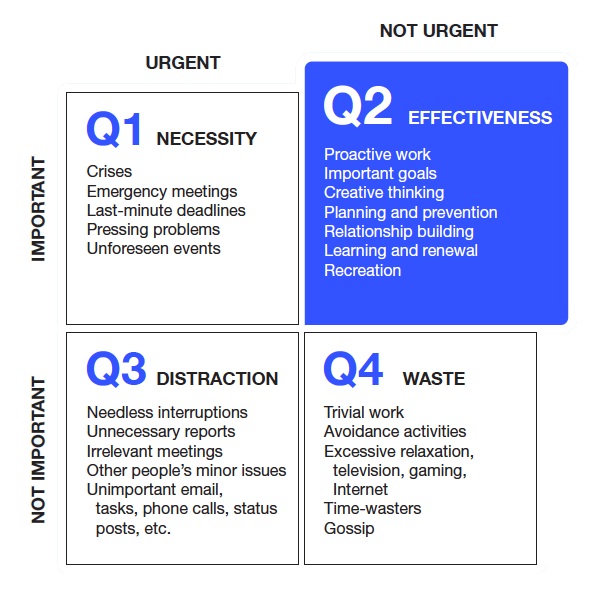
A two-year research timeline is only a limitation if the problem requires a two-week answer. For the problems that will determine whether your organization thrives or disappears over the next decade (e.g., the leadership pipeline, the eroding value proposition, the unexamined strategic assumptions) 18-30 months isn't too slow. It might be the minimum investment required to generate understanding proportionate to the problem's actual importance.
The Executive Doctorate Board (EDBO) represents a third option, one that draws on the rigor of academia and the responsiveness of consulting without inheriting the fatal limitations of either. And crucially, it's designed for the problems that deserve sustained, serious attention precisely because they'll never generate the urgency that forces it.
The Executive Doctorate Board: How It Works
The core insight is structural, not philosophical: There exists a population of researchers, DBA students, who are uniquely positioned to bridge the science-practice gap, but who lack a mechanism to connect with organizations that need them. Simultaneously, there exist organizations with genuine research-worthy problems who don't know this resource exists.
The Executive Doctorate Board is the matchmaker between these two groups.
Who are Doctorate in Business Administration (DBA) Researchers?
They are not traditional doctoral students. A typical doctoral candidate enters their program in their mid-twenties, straight from a master's degree, with minimal professional experience. They think science-first: "What theoretical question interests me? Now, where can I find data?"
Executive DBA students are fundamentally different. They enter their programs with ten, fifteen, sometimes twenty-plus years of senior professional experience. They've run teams, managed budgets, navigated politics, shipped products, and felt the consequences of bad decisions. They understand what a real business problem looks like because they've lived inside them. But they've also been trained rigorously in scientific methodology: research design, statistical analysis, validity and reliability, causal inference. They know how to move from an interesting question to a defensible answer.

This dual identity of practitioner and scientist enables something that neither pure academics nor pure consultants can offer: The ability to hear a business problem and immediately recognise its scientific structure. To see not just "we're struggling with retention" but "there's a predictive model here; let me identify the drivers." This is what one academic advisor called "the flipped model": instead of starting with science and hunting for data, you start with a business problem and transform it into rigorous research. Executive DBA students are built for exactly this flip.
What the Organization Gets
When a company engages with a researcher through EDBO, they receive:
Evidence, not opinions. Instead of a consultant's framework or a "best practice" recommendation, they get data-driven findings specific to their context. Not "companies like yours typically do X" but "in your organisation, the primary drivers of Y are A and B, with effect sizes of this magnitude."
Targeted precision. The classic employee survey measures thirty things and tells you which scores are low. Evidence-based research measures potential predictors and tells you which ones actually cause the outcome you're trying to manage. That's the difference between spreading effort across ten initiatives and focusing on two that account for 80% of the variance.
Rigor with oversight. Every DBA student has a faculty supervisor, i.e. a full professor ensuring conceptual coherence and methodological quality. The organisation isn't relying on a student working alone; they're accessing a research team with institutional accountability.
Investment matched to importance, not urgency. The EDBO model is designed for problems that deserve sustained attention. Preliminary findings can inform near-term decisions, but the full research arc produces the kind of deep understanding that Quadrant II problems demand, i.e. the kind that prevents crises rather than merely responding to them.
Cost that reflects a different value exchange. Because the DBA researcher's "payment" is the dissertation opportunity, i.e. access to data, a real-world research context, and a completed chapter of their doctoral work, the financial cost to the organisation is minimal. Often just expenses. This isn't discounted consulting; it's a fundamentally different economic model for generating evidence.
What the Researcher Gets
Data access. For any doctoral researcher, the single greatest challenge is finding an organisation willing to open its doors. Getting data starts with having a conversation and if an organization doesn't know you, that conversation never begins. EDBO solves the cold-start problem by connecting researchers with companies that have already articulated a need.
Real-world relevance. A dissertation grounded in a genuine organizational challenge carries more weight in academic evaluation, in future career opportunities, and in the researcher's own sense of purpose than one based on convenience data or hypothetical scenarios.
Professional network expansion. The engagement creates relationships that outlast the research itself, opening doors to future collaboration, advisory roles, or career transitions.
What the Faculty Gets
This isn't a model that asks professors to work for free. It's one that aligns with their existing incentives:
Research data without business development. Faculty supervising DBA students through EDBO gain access to corporate datasets they would otherwise need to cultivate through months of relationship-building and negotiation.
Co-authorship opportunities. Dissertation research that produces publishable findings benefits the supervisor's publication record as well as the student's.
Demonstrated impact. As universities increasingly value societal impact alongside traditional metrics, faculty who facilitate evidence-based corporate partnerships build a compelling impact narrative.
The Practical Reality: What This Looks Like in Action
Abstract models are easy to admire and hard to trust. So let's make this concrete.
Scenario: The Retention Problem
A mid-sized technology company is losing engineers at an alarming rate. The leadership team's priors:
• "It's a compensation problem; competitors are paying more."
• "Our managers aren't trained well enough."
• "The industry is hot; everyone is losing people."

Based on these priors, they're preparing to spend significantly on compensation adjustments and a management training program.
Now, this problem has urgency, i.e. people are leaving now. But the real question beneath it is a Quadrant II question: What actually drives talent retention in this organization, and how should resources be allocated to build a sustainably attractive workplace? That question doesn't have a deadline. It has consequences that compound over years.
Through EDBO, they connect with a DBA researcher whose expertise is in organizational behavior and workforce analytics. The researcher designs a rigorous study:
1. Defines the outcome precisely: voluntary turnover among engineers with 2-5 years of tenure (the population actually leaving, not everyone)
2. Identifies scientifically validated predictors: compensation satisfaction, manager quality, role clarity, psychological safety, career visibility, team cohesion, workload sustainability
3. Collects data through validated survey instruments and links it to actual turnover data over the following six months
4. Runs regression analyses to determine which predictors actually explain variance in turnover
The findings surprise everyone:
• Compensation satisfaction has a statistically insignificant relationship with turnover in this population
• Manager quality matters, but less than assumed
• Role clarity and career visibility are the dominant predictors, together explaining the majority of the variance

This is Bayes' theorem in organizational action. The leadership team's priors (held with high confidence, shaped by industry narratives and personal experience) are contradicted by context-specific evidence. The rational response: Update beliefs, redirect resources, and target interventions at what actually matters.
The company doesn't need a compensation overhaul. They need to clarify what success looks like in each engineering role and make career pathways visible and navigable. The cost of these interventions is a fraction of the planned salary adjustments. The impact is measurably larger.
Six months later, a follow-up measurement confirms: the targeted predictors have improved, unrelated variables are unaffected (confirming the mechanism), and turnover has declined.
This is not hypothetical. This is the methodology that evidence-based practitioners use every day. EDBO simply makes it accessible to organizations that couldn't otherwise access it.
Honest About the Challenges
Intellectual integrity requires naming what's hard. The Executive Doctorate Board faces real obstacles, and pretending otherwise would undermine the very evidence-based ethos it promotes.
The Awareness Problem
This model is genuinely novel. Companies aren't searching for "DBA researcher to solve my strategy problem" because the category doesn't exist in their mental model. The marketing challenge isn't competing with consultancies; it's creating awareness that a third option exists at all.
The Credibility Gap
A doctoral student, however experienced and well-supervised, doesn't carry the brand weight of McKinsey. For risk-averse executives, this matters. The path forward isn't to compete on brand, it's to compete on demonstrated results, building a portfolio of case studies where evidence-based approaches delivered measurably superior outcomes.
The Urgency Paradox
Here is perhaps the deepest challenge, and it's worth naming explicitly: The very problems EDBO is best suited to address, i.e. the important-but-not-urgent (the Quadrant II challenges), are precisely the problems organizations are least motivated to invest in. The energy companies investing in the transition are exceptions, not the rule. Most organizations default to the urgent, quarter after quarter, until the important becomes urgent—at which point it's often too late for research. It's time for triage.
EDBO's natural clients aren't average organizations. They're the ones with leaders who think long-term, who understand that the absence of urgency is not permission for inaction, who recognize that building evidence-generating capability now is the organizational equivalent of investing in renewable infrastructure before the oil runs out.

The Scale Question
Not every organization can participate. Very small companies may lack sufficient data for statistically meaningful analysis. Very large companies may default to the McKinsey Reflex regardless of alternatives. The natural market is the middle: Organizations large enough to have real data and real problems, but small enough or autonomous enough that a single decision-maker can say yes to something unconventional.
These challenges are real but they are engineering problems, not impossibility proofs. The evidence that the underlying model works, i.e. that targeted, evidence-based interventions outperform intuition-driven ones, is already overwhelming.
The Flywheel: Why This Gets Easier Over Time
Every successful EDBO engagement generates multiple forms of compounding value:
For the model itself: Each completed project produces a case study, a testimonial, and proof of concept. The credibility gap narrows with every demonstrated success.
For the participating organization: Companies that see results come back. "We have more problems that maybe you can help us with." The relationship deepens, the cost of engagement drops (trust and context are already established), and the organization builds an internal culture of evidence-based strategy.
For the research community: Each engagement produces publishable findings, expanding the evidence base for others. Cross-engagement patterns emerge, enabling insights that no single study could generate.
For the field: As success stories accumulate, the science-practice gap stops being an abstract complaint and starts being a measurably shrinking problem. Other institutions take notice and the model spreads.
This is the flywheel: Early engagements are the hardest, but each one makes the next easier, faster, and more valuable. Momentum builds and the gap closes.
A Different Kind of Competitive Advantage
Most competitive advantages are visible and therefore imitable. A new product can be copied. A pricing strategy can be matched. A marketing campaign can be outspent. But an organization that systematically generates better evidence, updates its beliefs more accurately, and targets its interventions more precisely builds an advantage that is nearly invisible from the outside—and extraordinarily difficult to replicate. Competitors see the outcomes but not the mechanism. They see the results but not the Bayesian engine producing them.
This is the evidence advantage: Not a single insight but a system for continuous improvement. Not a one-time correction of beliefs but a discipline of perpetual updating. Not a project but a capability. And it is, in Covey's terms, the ultimate Quadrant II investment. It will never feel urgent. No crisis will force an organization to build this capability. The quarterly numbers won't demand it. The board won't insist on it. It will always be possible to defer or say "next year," ... "after we deal with the current priority," ... "we're not ready yet."

The organizations that build this capability anyway, i.e. that invest on the basis of importance despite the absence of urgency, will compound their advantage over every planning cycle. Those that don't will continue making decisions based on priors that grow staler by the quarter, wondering why their strategies feel right but their results say otherwise. They will be the energy companies that never invested in the transition. They will look fine right up until the moment they don't.