
Executive Summary: Your Invitation to Advancing Excellence through Insight and Experience
Bayes' theorem teaches us that rationality isn't about certainty. It's about the willingness to update, i.e., to let evidence reshape what we believe, even when the old belief was comfortable, even when the new belief requires us to change course.
Covey teaches us that the most important work is the work that never feels urgent and that our greatest failure isn't choosing wrong in moments of crisis, but failing to invest in understanding during the long stretches when no crisis forces our hand.
The Executive Doctorate Board is built on both principles. It exists for leaders who suspect their priors might be wrong and want to find out. For organizations that recognize the difference between what's screaming for attention and what quietly determines their future. For the executive who understands that investing in evidence today even without a deadline, even without a crisis, even without a board mandate is what separates organizations that endure from those that simply react until reacting is no longer enough.

You don't need to abandon your experience. You don't need to distrust your instincts entirely. You need to test them rigorously, affordably, and with the kind of sustained attention that important problems deserve.
The science-practice gap has persisted for decades because no one built the bridge. The Executive Doctorate Board is that bridge: Connecting organizations that need evidence with researchers who can generate it, in a structure that serves both.
The question isn't whether evidence-based strategy works. That evidence is already in. The question is whether you'll invest in what's important before it becomes urgent or wait until it's too late to invest at all.
The Future of Strategy
A Confession Most Leaders Won't Make
Here's something that rarely gets said aloud in executive suites: most strategic decisions are educated guesses dressed up in PowerPoint.
Leaders know this intuitively. It's why they feel a knot in their stomach before committing to a major initiative. It's why they seek validation from consultants, peers, or industry reports (i.e., anything that makes the guess feel less like a guess). And it's why, when things go wrong, the first instinct is to point to the process rather than the evidence: "We followed best practice. We hired the best advisors. We did everything right." But did they?
Today, the companies that thrive are those that invest early in the important-but-not-yet-urgent issues that shape their future. But doing so requires a way of thinking that most leaders were never trained in: Evidence-Based Strategy.
The Executive Doctorate Board provides organizations with a new way to generate the evidence they need to address their most important long-term challenges before those challenges become crises.
Why Evidence-Based Strategy is the Antidote (based on a 18th-century formula that should run your strategy)
Evidence-based strategy is the discipline of making decisions grounded in the best available data, not assumptions or intuition. It requires high-quality evidence, rigorous analysis, and the ability to update beliefs as new information emerges.
In 1763, an essay was published posthumously by Thomas Bayes, a Presbyterian minister with a gift for mathematics. The idea it contained was deceptively simple: when you encounter new evidence, you should update your beliefs proportionally to the quality and relevance of that evidence.
And yet, Bayes' theorem is probably the single most important concept any leader can internalize. Because what it means for leaders is this: your beliefs are not certainties. They are probabilities and probabilities change when new evidence arrives.
Bayes’ theorem is a fundamental rule in probability theory that describes rationality as the process of continuous belief revision based on the best available evidence.
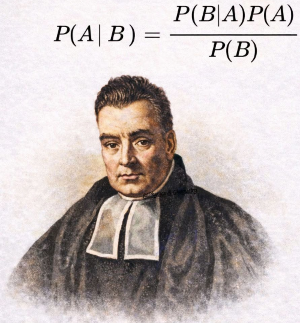
Every leader carries what Bayesians call priors, i.e. starting assumptions about how things work. For example, "our attrition problem is about compensation", "customers choose us for price", "remote work is hurting collaboration", "our leadership development program is working."
These priors aren't random. They're shaped by experience, culture, by what worked at the last company, or by what a respected mentor once said. They feel solid and earned. But feeling earned and being correct are different things. Bayes' theorem asks a disarmingly direct question: What would it take to change your mind? If the answer is "nothing", i.e. if no conceivable evidence could shift your belief, then you're not being strategic. You're being dogmatic. And dogma, in a volatile market, is expensive. The power of Bayesian thinking isn't that it makes you right. It's that it makes you less wrong over time. Each piece of quality evidence nudges your beliefs toward reality. A single study might not overturn a deeply held assumption. But as rigorous data accumulates, from your own organisation, from comparable contexts, from well-designed research, eventually the old belief becomes untenable. The rational response is to update and act accordingly.
But here's the catch that makes all of this theoretical rather than practical: Bayes' theorem only works if you actually have high-quality evidence to feed it. Without data, without rigorous analysis, without belief-forming information, you're left with nothing but your priors and biases. And those aren't strategy, no matter how confidently held.
The Important and the Urgent: A Dangerous Confusion
Dr. Stephen Covey drew an important distinction in The 7 Habits of Highly Effective People that fundamentally reframes how organizations should think about investing in evidence.
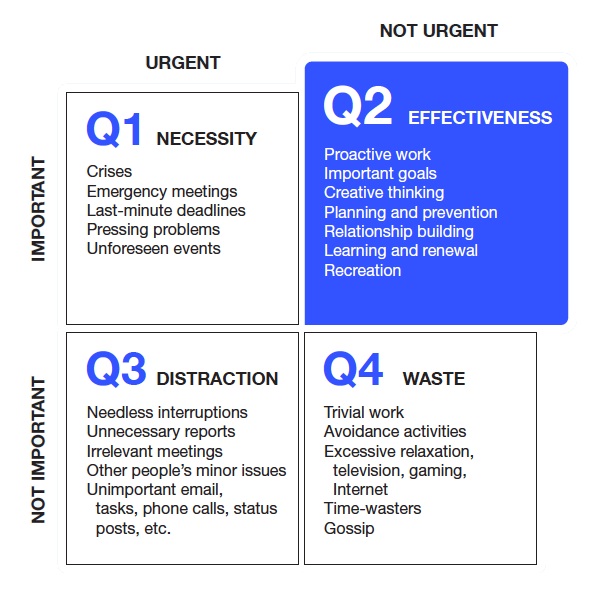
Covey observed that people have a chronic tendency to invest in problems that are urgent but not important, at the expense of problems that are important but not urgent. The urgent screams for attention. It comes with deadlines, with stakeholders asking pointed questions, with consequences measured in days. And so organisations respond reactively. The most consequential problems carry no urgency at all. They don't announce themselves and they don't come with deadlines. Rather, they sit quietly in the background, compounding in significance while generating zero pressure to act.
Consider how major energy companies are approaching the transition away from carbon-based fuels. No one handed them a memo with a date. There is no quarterly deadline for "become a renewable energy company." The transition might take two decades or more; the timing is genuinely uncertain.
And yet these companies are investing now billions in research, in infrastructure, in fundamental rethinking of their business models. Not because it's urgent. Next quarter's revenue still comes from oil and gas. No board is demanding a complete pivot by Friday. They're investing because it's existential. The logic is simple and stark: If you are not ready by the time the transition arrives, you are out of business. Not struggling or underperforming. The absence of urgency doesn't diminish the importance. If anything, it makes the problem more dangerous, because there is no external force compelling action until it's too late to act.
Important but not urgent is a strategic blind spot and organizations are surrounded by such management challenges that are deeply important but generate no sense of urgency.
The slow erosion of leadership capacity. No organisation wakes up one morning to discover its pipeline is empty. The erosion happens invisibly, over years. By the time it becomes urgent, i.e. when a CEO departs with no credible successor or when an entire generation of middle managers burns out, the window for building capacity has already closed.
The gradual obsolescence of a value proposition. A professional services firm whose differentiation is eroding doesn't face a single crisis moment. Clients drift away gradually. Margins compress incrementally. The firm that waits for urgency to motivate reinvention will find itself reinventing from a position of weakness.
The quiet accumulation of decision debt. Every strategic decision made on intuition rather than evidence adds a small amount of risk. No single bad decision is catastrophic but they compound silently until the organization discovers it has been optimizing for the wrong things for years, and competitors who invested in understanding have built an insurmountable lead.
The unexamined assumptions embedded in culture. "This is how we do things here" is never urgent to question until the market shifts, and the assumptions that felt like wisdom reveal themselves as anchors.
What other organizational challenges are important but not urgent, yet still existential? The list is endless: Loss of strategic alignment, declining innovation capacity, workforce disengagement, emerging competitive threats, shifts in societal expectations, etc.
These problems share a structure: the timing of their consequences is uncertain, the urgency is absent, but the importance is existential. These issues rarely trigger alarms but they compound quietly until they become irreversible. They are Covey's Quadrant II, i.e. the space where the most consequential work lives, and where organizations are most likely to underinvest because nothing is forcing their hand.
These are exactly the kinds of problems that require rigorous, evidence-based research; not quick fixes. The organization that doesn't understand what actually drives its performance, what actually predicts its vulnerabilities, what actually differentiates it in the eyes of its customers, that organization is the energy company that never invested in the transition. It will look fine right up until the moment it isn't. This is precisely the space where the science-practice gap does its greatest damage. Not in the crisis that demands immediate action but in the slow-moving, high-stakes challenges where the absence of evidence compounds quietly over years.
The Science-Practice Gap
In every major economy there is a bizarre structural failure that costs organizations billions annually. On one side: Universities producing extraordinary research about how organizations actually work, what drives performance, what predicts turnover, what makes teams effective, and what causes strategies to fail. On the other side: Companies desperately needing exactly this knowledge, making consequential decisions without it.
This is the science-practice gap, and its persistence is not accidental. It's sustained by a set of interlocking incentives that benefit almost everyone except the organizations making decisions in the dark.
Academics benefit because their career incentives reward journal publications, not corporate impact. A groundbreaking study about organizational behavior published in a top-tier journal advances a career regardless of whether a single practitioner ever reads it.
Consultants benefit because the gap creates demand for their services. If companies could easily access and apply scientific evidence, the premium for "strategic advice" would collapse. The gap is the consulting industry's moat.
Executives benefit, perversely, because the gap provides cover. If rigorous evidence were readily available and widely understood, leaders would be accountable for ignoring it. In the absence of accessible evidence, "we used our best judgement" remains a defensible position.
None of this is conspiracy. It's simply what happens when incentive structures don't align with outcomes and the result is predictable: Organizations spend enormous sums on advice that sounds authoritative but lacks scientific foundation, while research that could transform their strategies gathers dust in academic repositories.
The McKinsey Reflex: When Safety Beats Effectiveness
There's a pattern so common in corporate life that it deserves a name. Let's call it the McKinsey Reflex: A senior leader faces a complex problem. The stakes are high. Multiple options exist, each with uncertainty attached. The leader feels the weight of accountability; if this goes wrong, they'll need to explain why to their board, their investors, their team. In that moment of anxiety, the leader doesn't ask: "What approach would generate the best evidence for making this decision?"
They ask: "What approach would be easiest to defend if things go badly?" And the answer to that second question is almost always the same: hire a brand-name consultancy. Not because consultancies reliably produce superior outcomes, the evidence on that is decidedly mixed, but because hiring McKinsey is an unjudgeable decision. It's defensible even when the output isn't.

This creates a remarkable dynamic. One researcher described it from direct experience: Their evidence-based consultancy wrote a proposal that was clearly superior, i.e. tailored precisely to the organization's stated problem and grounded in rigorous methodology but the contract went to a brand-name consultancy. Later, through contacts inside the organization, they learned the client was "super frustrated with the low quality" of what the consulting firm delivered and that "whatever they did doesn't make any effect" on the outcomes they were trying to manage.
But the decision-maker who chose the firm was never questioned because the choice itself was safe, regardless of results. This is accountability anxiety in action: A systematic bias toward defensibility over effectiveness that pervades corporate decision-making and it is extraordinarily difficult to disrupt because it's rational at the individual level even as it's destructive at the firm level.
Notice, though, how the McKinsey Reflex is itself a response to urgency. The problem feels pressing. The leader needs to be seen acting. The consultancy provides immediate cover but the real problem, i.e. the slow-building strategic vulnerability, the unexamined assumptions, the accumulating decision debt remains unaddressed.
What If There Were a Better Way?
In part 2 of this blog you will learn how the Executive Doctorate Board works to close the science-practice gap and how organizations prepare for the future with evidence-based strategy before the future arrives.
Read article